Cardinal Property Management
Maintenance that runs on a schedule, not a phone call.
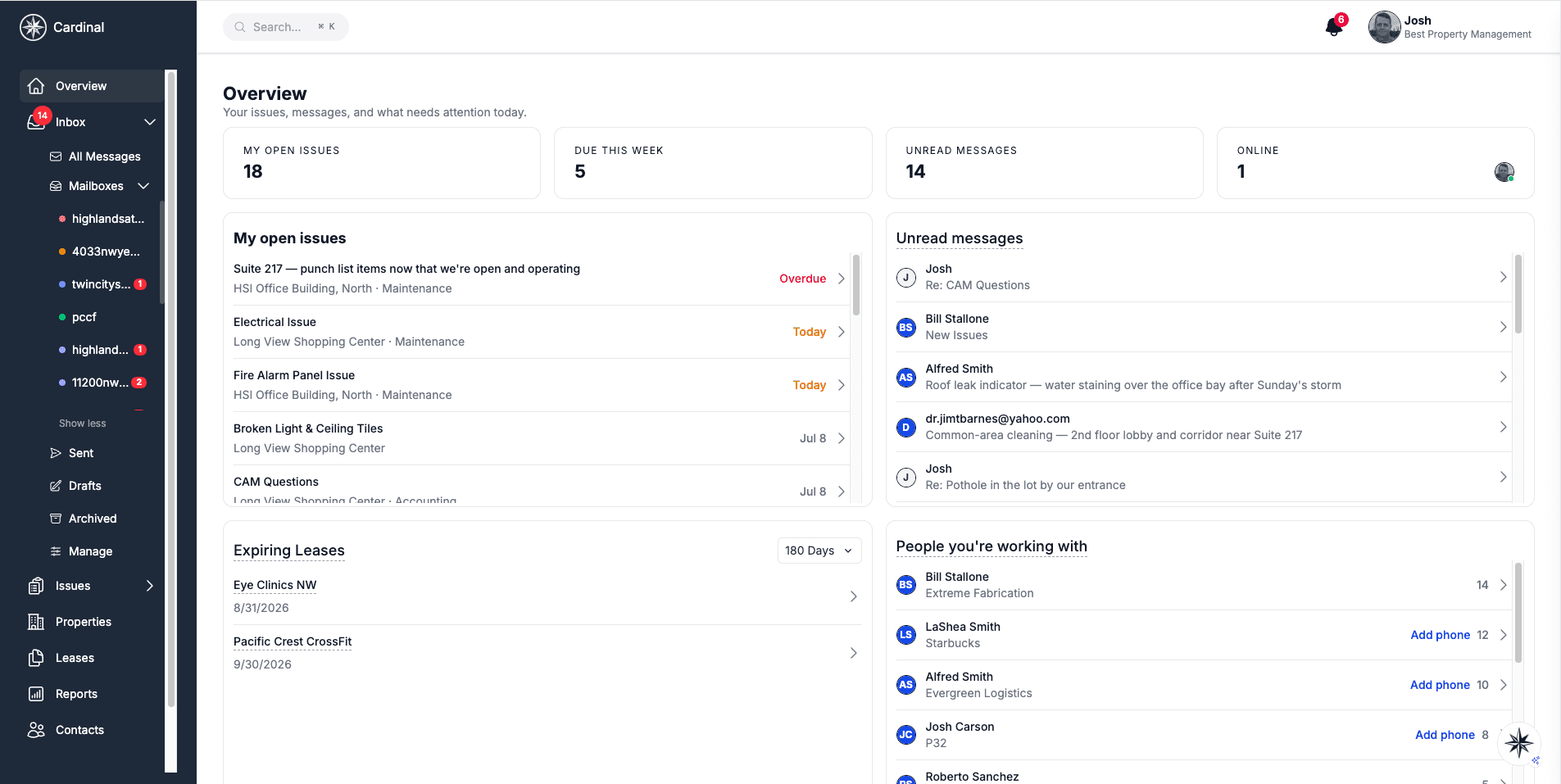
Cardinal provides facilities management for office, retail, and industrial properties in Portland, across Oregon, and in Southwest Washington: preventive maintenance programs, vendor sourcing and oversight, building systems management, and coordination of capital projects. Work orders are tracked from intake to close in the Cardinal platform, so deferred maintenance shows up as a list rather than as a failure.
What's included
- Preventive maintenance program
- A written schedule per building system — HVAC, roof, life safety, elevators, parking — so service happens on an interval instead of after a tenant complaint.
- An on-staff engineer, with every trade subcontracted
- Cardinal employs a building engineer who handles routine maintenance and after-hours response, so the person who knows your building is a Cardinal employee rather than whoever the dispatch queue sends. Every other trade is competitively subcontracted, insurance-verified annually, supervised on site, and invoiced against the scope that was authorized.
- Work order intake and tracking
- One intake path for tenants and staff. Work is triaged and scheduled between same day and two business days depending on location, with every order timestamped, assigned, and visible to you until it closes.
- Building systems and compliance
- Inspection and certification tracking for the systems that carry regulatory deadlines, with the paperwork stored against the property.
- Capital project coordination
- Scoping, bidding, and management of roof replacements, TI buildouts, and system upgrades, with cost tracking against the approved budget.
On what schedule
Service is a system, which means it runs on intervals rather than on whoever shouts loudest.
- Work order triaged and scheduled
- Typically same day to 2 business days, by location
- After-hours emergency on site (Portland metro)
- Typically within the hour
- Preventive maintenance schedule reviewed
- Annually, at budget time
- Vendor insurance re-verified
- Annually
These are the operating targets Cardinal holds itself to, not contractual guarantees. Every request, inspection, and report is timestamped in the Cardinal platform, so owners can see actual performance against these targets rather than take them on trust.
Deferred maintenance you can actually see.
Most owners learn about deferred maintenance when something fails or when a buyer’s inspector finds it. Because every work order, inspection finding, and vendor visit is recorded against the property, the backlog is a list you can read at any time — which makes capital planning an exercise in prioritization rather than discovery.
Frequently asked questions
- What is the difference between property management and facilities management?
- Property management covers the commercial and financial relationship with tenants — leases, rent, renewals, and reporting. Facilities management covers the physical building: preventive maintenance, building systems, vendors, and capital projects. Cardinal provides both, and most owners engage them together.
- Does Cardinal use in-house maintenance staff or subcontracted vendors?
- Both, and the split is simple: Cardinal employs a building engineer who handles routine maintenance and answers after-hours calls, so the person most familiar with your building is on staff rather than dispatched. Every other trade is subcontracted — competitively sourced, insurance-verified annually, supervised on site by Cardinal staff, and invoiced through at cost with no markup on coordination.
- Does Cardinal mark up maintenance and vendor invoices?
- No. Cardinal charges a standard market management fee and passes vendor invoices through at cost. There are no markups on maintenance coordination and no surprise charges — every fee is disclosed before you sign, including after-hours labor rates.
- How are after-hours emergencies handled?
- After-hours calls are answered by Cardinal’s on-staff building engineer. In the Portland metro the aim is to be on site within the hour; outlying markets take longer because of travel and vendor coordination, so treat that as a target rather than a guarantee. After-hours labor is billed at after-hours rates, disclosed in advance. The resulting work order and its resolution are logged against the property like any other.
Let's discuss your portfolio.
We'll walk one of your properties with you and show you exactly what management and visibility would look like — before you commit to anything broader. No pitch deck. Just the actual operating view.