Cardinal Property Management
Books that close before the news gets stale.
Cardinal provides property-level accounting for commercial owners in Portland, across Oregon, and in Southwest Washington: monthly owner reporting, accounts payable and receivable, annual budget preparation, and common area maintenance (CAM) reconciliation. Reporting is targeted for the 15th of the following month rather than whenever the books happen to close, so a variance reaches you while you can still act on it.
What's included
- Monthly owner reporting package
- Income statement, balance sheet, rent roll, delinquency detail, and variance commentary explaining what moved and why — targeted for the 15th of the following month.
- Accounts payable and receivable
- Vendor invoices reviewed against authorized scope and paid on terms; tenant billing and collection with aging reviewed twice monthly as standard policy. AP and AR processes are aligned with each owner during onboarding, so approval thresholds and collection escalation match how you actually want them handled.
- Annual budget preparation
- A property-level operating and capital budget built from actual history and the maintenance backlog. Timing is set with each owner, generally aiming to complete the coming year’s budget by Thanksgiving, and working back from any budget notice or review period the leases require.
- CAM reconciliation
- Annual reconciliation of recoverable operating expenses against tenant estimates, with per-tenant statements and the workpapers behind them, targeted for completion within 90 days of year end.
- Year-end support for your CPA
- Trial balance, supporting schedules, and answers, so your tax preparer is not reconstructing the year from bank statements.
On what schedule
Service is a system, which means it runs on intervals rather than on whoever shouts loudest.
- Monthly owner report delivered
- Targeted for the 15th
- Delinquency and aging review
- Twice monthly
- CAM reconciliation completed
- Targeted within 90 days of year end
- Annual operating budget completed
- Generally by Thanksgiving, timed with each owner
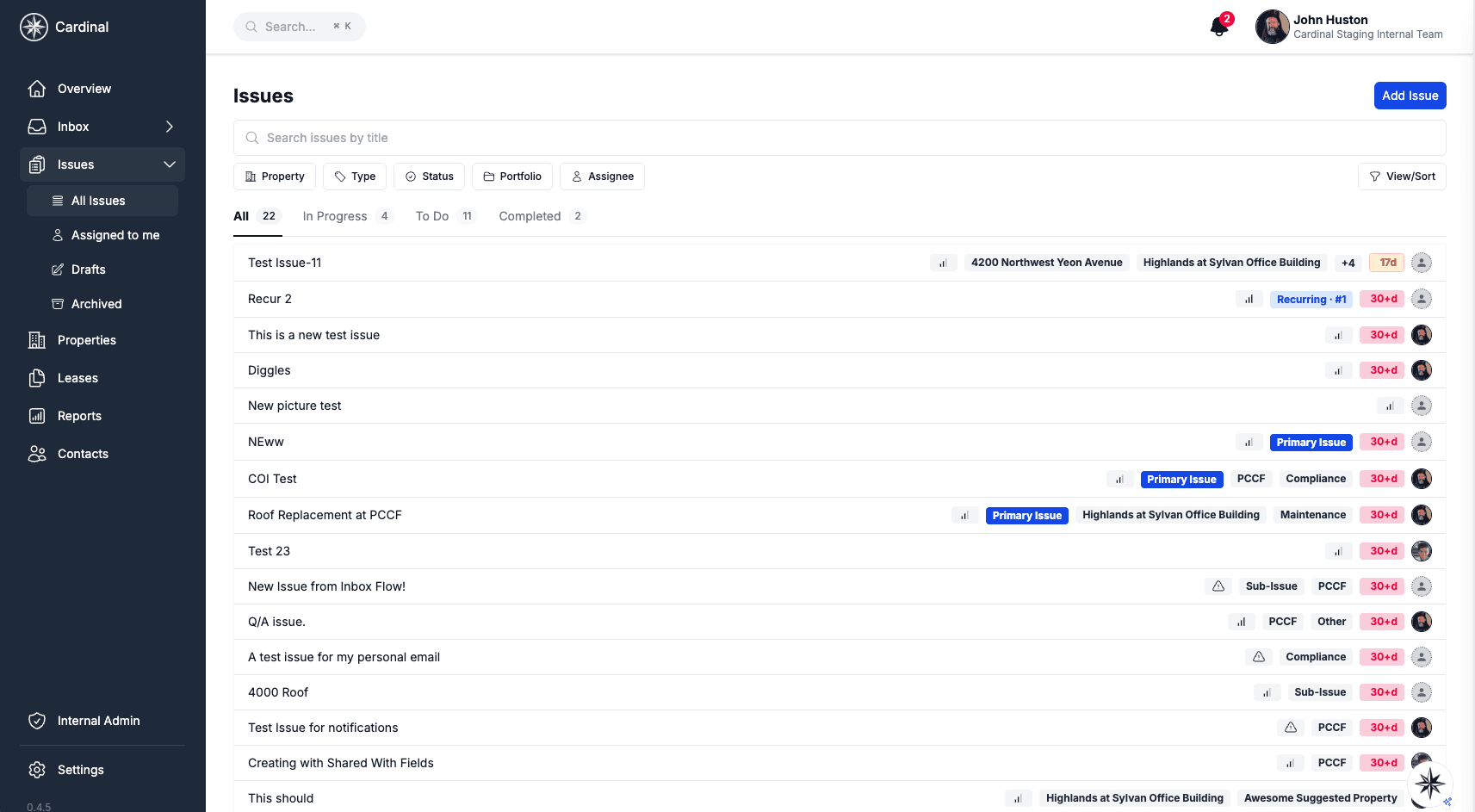
These are the operating targets Cardinal holds itself to, not contractual guarantees. Every request, inspection, and report is timestamped in the Cardinal platform, so owners can see actual performance against these targets rather than take them on trust.
Reporting is a by-product of the work, not a project.
Late reporting is usually a symptom: the underlying records live in several places and someone has to assemble them. Because tenant communication, vendor invoices, and issue history are already recorded against the property in Cardinal, the monthly package is compiled from work that has already happened rather than reconstructed at month end.
Frequently asked questions
- What is CAM reconciliation?
- CAM reconciliation is the annual process of comparing what tenants paid in estimated common area maintenance charges against the landlord’s actual recoverable operating expenses for the year, then billing or crediting each tenant the difference. It requires classifying every expense as recoverable or not under each lease’s specific language, applying each tenant’s pro-rata share, and honoring any caps, exclusions, or base-year provisions that lease contains.
- When should CAM reconciliations be completed?
- Most commercial leases require reconciliation statements within a set number of months after year end, and some bar the landlord from recovering underbilled amounts if that deadline is missed. Cardinal targets completion within 90 days of year end and tracks each lease’s specific deadline as a critical date, so the lease’s own requirement governs where it is tighter.
- What should a monthly owner report include?
- At minimum: an income statement showing actual against budget, a balance sheet, a current rent roll, delinquency detail by tenant, and written commentary explaining material variances. Cardinal targets delivery by the 15th of the following month, plus the operational context behind the numbers — open issues, completed work, and upcoming lease events.
- When will I receive next year’s operating budget?
- Budget timing is set with each owner, but Cardinal generally aims to complete the coming year’s operating and capital budget by Thanksgiving — early enough that an owner has real time with it before the year starts. Where a lease stipulates a budget notice or review period for tenants, Cardinal works backward from that deadline so the requirement is met rather than discovered late.
- Does Cardinal replace my accounting software like Yardi, AppFolio, or MRI?
- No. Cardinal complements accounting platforms rather than replacing them. The accounting system keeps its job as the system of record for the general ledger; Cardinal handles the operational layer — communication, documentation, issue tracking, and owner visibility — and connects it to the financial reporting.
Let's discuss your portfolio.
We'll walk one of your properties with you and show you exactly what management and visibility would look like — before you commit to anything broader. No pitch deck. Just the actual operating view.